Accessible Virtual and Augmented Reality Learning
Make VR and AR learning accessible, reviewed across cognitive demand, sensory access, flexibility, disclosure, support and individual variation.
By DoviLearn® Insights Team
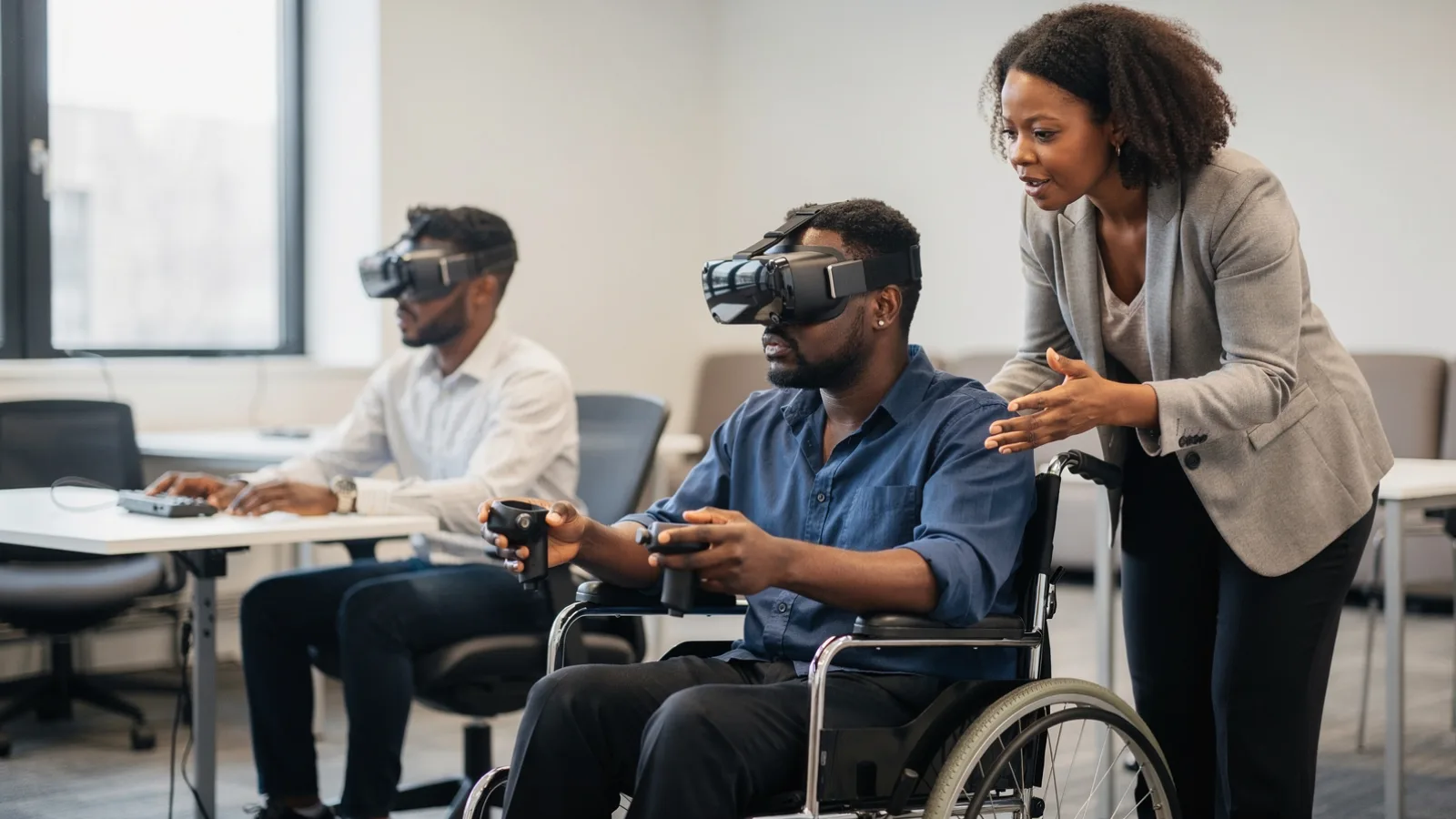
Virtual and augmented reality can place learners inside a situation in ways a screen cannot. The same qualities that make it powerful, intense sensory input and physical interaction, also make it easy to exclude people. Accessible immersive learning starts from the assumption that learners differ in sight, hearing, movement and sensory tolerance.
Plan accessibility into the experience
Accessibility in immersive media cannot be retrofitted cheaply. The note sets out the needs of people with disabilities in virtual, augmented and mixed reality environments and requirements for accessible XR. [c-xaur] Treating those needs as design inputs from the first storyboard keeps the experience open to everyone.
Editorial illustration representing the article subject. ⚠ AI-generated editorial illustration. It represents the article’s subject and does not document a real event or identify real people.
Close
AI-generated editorial illustration. It represents the article’s subject and does not document a real event or identify real people.
An inclusion review for VR and AR
• Cognitive demand: can the pace and complexity be lowered, with clear goals and no hidden time pressure?
• Sensory access: are captions, audio description, adjustable motion and comfort options built in?
• Flexibility: is there a seated mode and a non-headset alternative for the same learning?
• Disclosure: can learners set comfort and access preferences without explaining why?
• Support: is a facilitator or help route available during and after the session?
• Individual variation: can controls be remapped for different movement and input needs?
Offer an equivalent, not a lesser, alternative
Some learners will not or cannot use a headset. The goal is an alternative that teaches the same thing, such as a seated or flat-screen version, rather than a thinner experience that quietly offers less. Equivalence is the test, and it separates population-level design from the individual accommodation a specific learner may still need.
Where DoviLearn® fits
Adaptive scenario and immersive design can be run through this review. The DoviLearn® learning technology context explains the delivery options and the DoviLearn® research context explains the evidence. Decisions about fidelity, assessment and accommodation stay with educators and the organisation, and the example demonstrates a process rather than guaranteed learning, employment or business outcomes.
Related reading
• Context: the power of collaboration .
• Related: immersive learning for adult education .
• Hub: AI tutoring for neurodivergent learners .
References
• XR Accessibility User Requirements , W3C Accessible Platform Architectures Working Group. Working Group Note: user needs for immersive, augmented and virtual reality